
How Claude AI Can Transform a Digital Marketing Agency
Artificial intelligence is changing the way digital marketing agencies create content, understand customers, manage campaigns, and improve productivity. Among the growing number of AI tools available today, Claude AI has become a useful assistant for marketing teams that need to handle large amounts of content and information efficiently.
For digital marketing agencies, Claude AI can help reduce repetitive work, speed up content production, generate ideas, analyze information, and support better marketing decisions. However, it works best as an assistant to marketers rather than a complete replacement for human creativity and strategy.
What Is Claude AI?
Claude AI is an artificial intelligence assistant developed by Anthropic. It can understand and generate natural-language content, summarize information, analyze documents, brainstorm ideas, and assist with a wide range of business and marketing tasks.
For a digital marketing agency, Claude can act like a virtual marketing assistant that supports different teams, including content writers, SEO specialists, social media managers, email marketers, and strategists.
How Can a Digital Marketing Agency Use Claude AI?
1. Content Creation
Content creation is one of the most time-consuming activities in digital marketing. Agencies often need to create blog posts, website copy, social media captions, product descriptions, email campaigns, and advertisements.
Claude AI can help marketers:
- Generate content ideas
- Create blog outlines
- Draft articles
- Write social media captions
- Create product descriptions
- Develop email drafts
- Rewrite existing content
- Adapt content for different audiences
For example, a marketing agency working with a fitness brand can use Claude to brainstorm blog topics such as “Beginner’s Guide to Muscle Building” or “Best Pre-Workout Nutrition Tips.”
Human marketers can then review, fact-check, edit, and add the brand’s unique voice before publishing.
2. SEO Content Planning
SEO requires consistent research, planning, and content production. Claude AI can assist SEO teams with various parts of the content-planning process.
It can help generate:
- Keyword-based content ideas
- Blog structures
- FAQ ideas
- Title variations
- Meta description drafts
- Search-intent-based content outlines
- Internal linking suggestions
For example, instead of starting a blog from a blank page, an SEO specialist can provide a target keyword and ask Claude to create a structured outline based on different search intents.
The SEO professional should still validate keywords, search volume, competition, SERP results, and other SEO factors using dedicated SEO tools.
3. Social Media Marketing
Managing multiple social media accounts can be challenging for agencies. Every platform requires different content formats and communication styles.
Claude can help create variations of the same campaign for:
- X
- Short-form video scripts
- Promotional campaigns
For example, one product announcement can be transformed into a professional LinkedIn post, an engaging Instagram caption, and a shorter social media update.
This allows social media teams to spend more time on strategy, community engagement, and performance analysis.
4. Email Marketing
Email marketing requires attractive subject lines, persuasive copy, clear calls-to-action, and audience-specific messaging.
Claude AI can assist marketers in creating:
- Email subject lines
- Promotional emails
- Welcome sequences
- Newsletter drafts
- Abandoned-cart messages
- Follow-up emails
- Different versions for A/B testing
A marketer can provide the campaign objective, target audience, offer, and desired tone, and Claude can generate several starting points.
The final email should still be reviewed by a human to ensure that the messaging is accurate and aligned with the brand.
5. Creating Advertising Copy
Digital advertising often requires multiple variations of headlines and descriptions.
Claude can help agencies brainstorm advertising copy for campaigns across platforms such as Google Ads and social advertising channels.
For example, a marketing team can ask Claude to generate multiple headline concepts around a particular product benefit.
Instead of manually creating dozens of variations from scratch, marketers can use AI to generate initial ideas and then select and improve the strongest versions.
6. Market and Audience Research
Understanding the target audience is essential for successful digital marketing.
Claude can help marketers organize and summarize large amounts of information, including customer feedback, survey responses, interview notes, and research documents.
Agencies can use it to identify:
- Common customer problems
- Frequently mentioned features
- Customer objections
- Buying motivations
- Frequently asked questions
- Potential content topics
This can help marketing teams better understand what their audience is talking about and use those insights when developing campaigns.
7. Competitor Analysis
Competitive research is another area where AI can support digital marketing teams.
Marketing professionals can provide publicly available competitor information and ask Claude to organize it into useful categories such as:
- Content strategy
- Brand messaging
- Product positioning
- Customer pain points
- Marketing themes
- Potential opportunities
However, marketers should verify information independently rather than treating AI-generated analysis as automatically accurate.
8. Marketing Reports and Data Interpretation
Digital marketing agencies generate large amounts of data from campaigns.
Claude can help marketers interpret and summarize information from reports, spreadsheets, and campaign documentation.
For example, an agency may use AI to help turn campaign data into a simple summary:
Campaign Performance
- Traffic increased
- Conversion rate improved
- One advertising channel generated more leads
- Certain content topics received higher engagement
This can make reporting easier for account managers and clients.
AI should support the interpretation process, while important business decisions should remain based on verified data.
9. Client Communication
Digital marketing agencies communicate with clients regularly. Claude can help teams prepare:
- Client emails
- Campaign updates
- Meeting summaries
- Project proposals
- Monthly report explanations
- Marketing recommendations
This can save time and make communication more consistent.
10. Marketing Strategy Brainstorming
Sometimes the biggest challenge isn’t execution—it is coming up with new ideas.
Claude can act as a brainstorming partner for marketing teams.
For example, an agency can ask it to generate campaign concepts for a new product launch, seasonal promotion, social media campaign, or brand awareness initiative.
The marketing team can then evaluate the ideas based on budget, audience, competition, brand identity, and expected results.
Benefits of Claude AI for Digital Marketing Agencies
Using Claude AI strategically can provide several advantages.
Faster Content Production
AI can help marketers create first drafts and ideas much faster, reducing the time spent starting from scratch.
Increased Productivity
Automating repetitive tasks allows employees to focus more on strategy, creativity, client relationships, and campaign optimization.
Better Content Ideation
Claude can generate multiple ideas quickly, helping marketing teams overcome creative blocks.
Improved Workflow
Agencies can use AI throughout different stages of a campaign, from brainstorming and content creation to reporting and communication.
Scalability
AI assistance can make it easier for agencies to handle a larger volume of content and marketing tasks without increasing workload at the same rate.
Is Claude AI Going to Replace Digital Marketers?
No. Claude AI should be viewed as a marketing assistant rather than a replacement for marketers.
Successful digital marketing requires creativity, strategic thinking, brand understanding, customer psychology, data interpretation, and decision-making.
AI can generate content and ideas, but humans are still responsible for:
- Brand strategy
- Fact-checking
- Creative direction
- Marketing decisions
- Understanding customers
- Reviewing AI-generated content
- Ensuring accuracy and originality
The strongest approach is AI + human expertise.
Best Practices for Using Claude AI in a Marketing Agency
To get better results from Claude AI, agencies should follow a few important practices:
Give clear instructions: Provide the audience, objective, tone, format, and context.
Provide brand guidelines: Give AI information about the brand’s voice, target customers, products, and communication style.
Review every important output: AI-generated content should be checked for accuracy, relevance, originality, and tone.
Don’t rely on AI for everything: Strategy and final decisions should remain with experienced marketing professionals.
Protect confidential information: Agencies should follow appropriate privacy and data-handling policies when working with client information.
The Future of AI in Digital Marketing
AI is becoming an increasingly important part of modern marketing workflows. Tools such as Claude can help agencies work faster and handle repetitive tasks more efficiently.
The future is not necessarily about replacing marketing professionals with AI. Instead, agencies that learn how to combine AI tools, human creativity, marketing expertise, and reliable data can gain a significant productivity advantage.
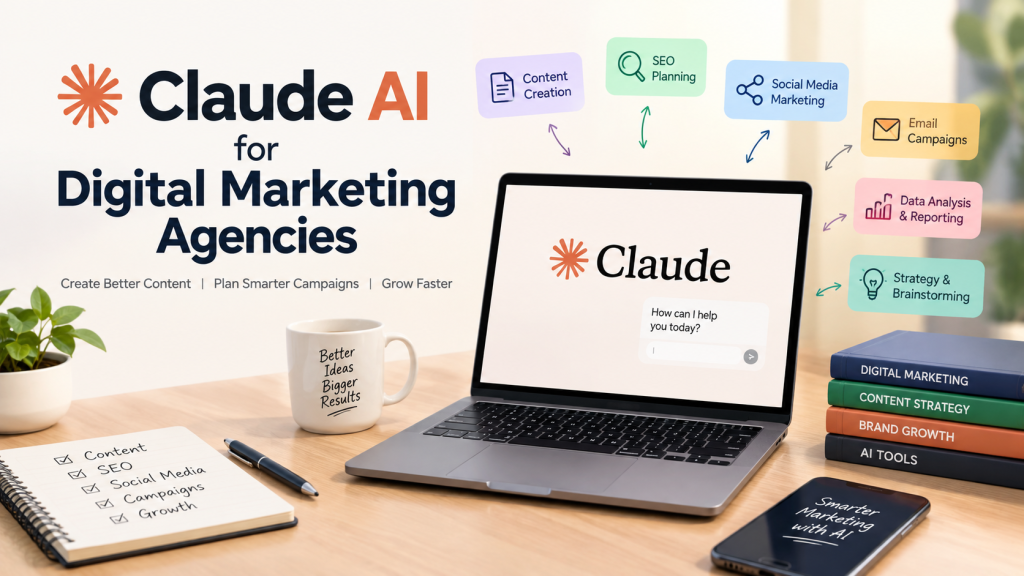
For digital marketing agencies, Claude AI can become a valuable tool for content creation, SEO planning, social media, email marketing, research, reporting, and brainstorming.
Conclusion
Claude AI has the potential to become a powerful productivity tool for digital marketing agencies. From creating content and social media posts to analyzing customer feedback and preparing reports, it can support marketers across many stages of the marketing process.
However, the best results come when AI is used as an assistant—not as a replacement for human expertise.
Digital marketing agencies that strategically integrate AI into their workflows can save time, increase productivity, scale content operations, and spend more time on what matters most: building effective marketing strategies and delivering better results for clients.